Views: 0 Author: Site Editor Publish Time: 2026-08-31 Origin: Site

Traditional chemical oxygen demand (COD) testing relies heavily on hazardous reagents like dichromate. It generates toxic waste and imposes a long two-hour delay between sampling and final results. You cannot manage dynamic biological processes efficiently using outdated historical data. Modern wastewater facilities face increasingly strict compliance targets alongside rapidly rising energy costs. They require real-time process control rather than delayed laboratory snapshots. Operators need actionable insights instantly to protect sensitive biological basins.
A reagent-free COD sensor provides continuous data for proactive decision-making. Because these devices rely on surrogate spectral measurements, they cannot universally replace official lab testing. This guide covers exactly when you should deploy them in your plant. You will also learn when you should avoid them entirely. Finally, we explore how you can evaluate and successfully adopt this specific technology for your facility.
Operational Shift: Online organic load sensors eliminate toxic reagent procurement and disposal costs while enabling real-time aeration control.
Technology Reality: UV absorbance is a surrogate measurement; successful deployment requires a consistent wastewater matrix and rigorous initial field calibration against standard grab samples.
Best Use Cases: Most effective for influent load monitoring, aeration optimization, and final effluent alarming in municipal or stable industrial wastewater applications.
Implementation Requirement: Facilities must commit to an initial 2-to-4-week calibration phase and establish a routine cleaning schedule for optical windows (even with auto-wipers).
Delayed lab results lead directly to reactive plant management. Operators often over-aerate biological basins simply to be safe. You waste massive amounts of electricity doing this continuously. Alternatively, operators miss toxic shock loads entirely. By the time the lab results arrive, the biomass is already compromised or dying. You cannot reverse biological die-off quickly. This reactive cycle jeopardizes plant stability and drives up daily operational expenses.
Adopting optical monitoring brings immediate cost avoidance opportunities. You eliminate consumable chemical reagents entirely from your daily budget. You also reduce hazardous waste disposal fees significantly. Lab technicians spend fewer manual labor hours analyzing routine daily grab samples. They can focus on higher-value quality assurance tasks instead. You save money directly on procurement and hazardous waste management.
Energy optimization represents another massive financial benefit. You can integrate continuous wastewater COD monitoring data directly into your plant SCADA systems. This integration allows you to control aeration blowers dynamically using a PID control loop. You supply oxygen based strictly on the actual incoming organic load. Plants utilizing feed-forward aeration often see electrical reductions reaching twenty percent.
Instant alarming helps you mitigate severe operational risks. You catch unexpected high-load events right at the plant inlet. You can immediately divert this highly contaminated flow into holding tanks. This diversion protects delicate biological processes from severe shock disruption. You avoid costly biological recovery periods and potential regulatory discharge violations.
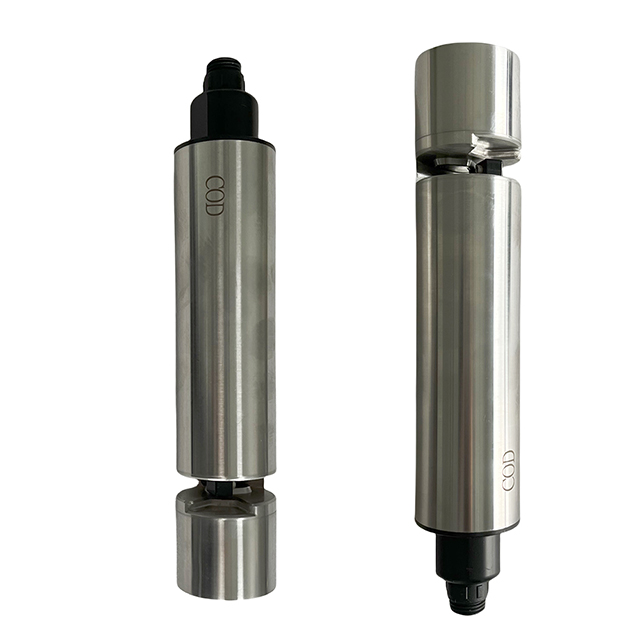
Certain organic compounds absorb ultraviolet light naturally. They typically absorb energy strongly at the 254 nm wavelength. A UV water quality sensor measures this specific light absorbance continuously. The internal microprocessor then correlates this optical data to the actual COD concentration. This principle leverages the Beer-Lambert law. More organic matter in the water means less ultraviolet light reaches the internal detector.
You must understand the sensor does not measure COD directly. It measures UV absorbance (UVA) or broad UV-Vis spectral data. You must establish a site-specific mathematical correlation. We call this the UVA-to-COD ratio. You program this specific ratio into the controller during initial plant commissioning. If your wastewater characteristics change, this ratio might need an update to remain accurate.
Turbidity and suspended solids cause significant measurement interference. These particles scatter the light beam randomly. This scattering artificially inflates the absorbance readings if left uncorrected. Modern sensors use dual-beam or multi-wavelength reference channels to solve this. They often use 550 nm or 880 nm wavelengths to detect solids. The internal algorithm continuously subtracts this turbidity interference from the primary UV reading. You get much more reliable organic measurements as a result.
Monitoring at the plant inlet or headworks delivers tremendous value. You detect incoming shock loads extremely early in the process. You characterize the raw wastewater profile in real time. This early warning prepares your downstream biological stages for sudden changes. Operators can adjust chemical dosing or divert flows before the damage actually occurs.
Primary clarifier effluent monitoring represents another perfect deployment location. You monitor the direct feed entering the main aeration basin. A reliable online organic load sensor provides feed-forward aeration control data. You ramp up blower speeds precisely before the heavy organic load hits the biology. This prevents sudden dissolved oxygen crashes during peak load hours.
Final effluent discharge channels also benefit from continuous optical monitoring. You establish a robust compliance safety net before releasing water. You gain valuable trend analysis before discharging water to surface streams. This continuous data ensures regulatory confidence between official manual lab tests. If an upset occurs, the system triggers an immediate alarm to halt the discharge.
Stable industrial effluents present highly favorable conditions for this technology. Facilities like breweries, dairies, and food processing plants benefit greatly. Their organic composition remains relatively uniform day after day. This consistent molecular makeup makes optical correlation highly accurate and dependably stable over long periods.
Highly variable industrial matrices break the core measurement logic. Chemical manufacturing plants often change product lines daily or weekly. The specific types of organic compounds shift drastically during these transitions. When the molecular makeup changes, the baseline UVA-to-COD correlation breaks down completely. You cannot rely on optical sensors in these unpredictable environments. They will output wildly inaccurate data.
High-fouling environments without maintenance will destroy your data reliability. Certain wastewater applications contain heavy fats, oils, and grease (FOG). Extreme grease exceeds the cleaning capacity of automatic mechanical wipers. Even compressed air cleaning systems fail under thick FOG layers. You must avoid deploying delicate optics here unless you commit to rigorous daily manual cleaning routines.
You must not use these devices for official regulatory reporting in most regions. Environmental agencies like the US EPA maintain strict compliance rules. They rarely approve UV or Vis spectral methods for official discharge reporting. You still need standard titration or colorimetric methods to satisfy legal documentation requirements. A UVCOD sensor remains strictly a process control and trending tool.
You must choose between single-wavelength and full-spectrum technologies. UV254 sensors measure a single specific wavelength. UV-Vis spectrometers measure a wide band across multiple wavelengths. As a general rule of thumb, single-wavelength devices are sufficient for stable municipal water. UV-Vis spectrometers handle complex, variable matrices much better. They use advanced algorithms to untangle overlapping absorbances.
Feature | Single-Wavelength (UV254) | Full Spectrum (UV-Vis) |
|---|---|---|
Cost | Highly cost-effective | Premium investment |
Matrix Suitability | Stable, predictable wastewater | Complex, mildly fluctuating wastewater |
Maintenance Complexity | Low to moderate | Moderate to high |
Algorithm Type | Simple linear or polynomial | Complex chemometric models |
Evaluate fouling defense mechanisms very carefully during procurement. Look closely at mechanical cleaning options like nano-coated wipers. Look into ultrasonic cleaning features or high-pressure air-blast systems. Automatic cleaning is completely non-negotiable for raw wastewater applications. Sensors lacking robust self-cleaning hardware will blind within hours in a primary clarifier.
The calibration interface determines your long-term operational success. The controller software must be highly intuitive for field operators. Operators need to easily input lab grab-sample data directly into the screen. This lets them build and adjust local calibration curves locally. You should not require paid vendor intervention for basic curve adjustments.
Integration and modularity ensure your investment remains future-proof. Ensure the device supports standard industrial communication protocols. Look for Modbus RTU, 4-20mA, or Profibus connections natively. The controller should ideally measure parallel parameters simultaneously. Some controllers handle BOD, TSS, and Nitrates from a single centralized unit.
Successful deployment requires strict adherence to a phased rollout plan. Facilities failing to respect the initial setup phases typically abandon the technology. You must follow these specific implementation realities.
Phase 1: The Calibration Period. Assume a mandatory two-to-four-week tuning phase. Operators must take daily grab samples. They must pull these samples at the exact sensor location. They analyze them in the lab. Finally, they input the paired data to train the sensor's algorithm accurately.
Phase 2: Baseline Shifting. Baseline shifting happens due to natural seasonal changes. Wastewater temperature and biological activity fluctuate throughout the year. You may require quarterly adjustments to the correlation curve. This keeps the sensor tracking closely with seasonal matrix shifts.
Phase 3: Preventive Maintenance. Preventive maintenance remains absolutely critical. Even automatic wipers cannot prevent all mineral buildup. Establish a monthly manual inspection protocol. Clean the optical windows using a diluted 5% acid solution. This removes stubborn mineral scaling effectively without scratching the sapphire lens.
Transitioning to reagent-free optical monitoring is a high-ROI decision for process control. You must simply understand it remains a correlative technology rather than a direct measurement. It provides the real-time visibility necessary to optimize aeration and prevent biological shocks. Prioritize vendors offering transparent trial periods for initial matrix validation. Choose equipment featuring robust auto-cleaning hardware and intuitive local calibration software. Contact your engineering teams or local vendors today. Request a site-specific matrix evaluation. Alternatively, schedule a pilot deployment directly at your plant inlet to verify correlation accuracy.
A: In most global jurisdictions, UV absorbance serves strictly for internal process control and trend alarming. Environmental agencies rarely accept surrogate optical data for official compliance reporting. You typically still need approved laboratory methods, like dichromate titration, for your legal discharge documentation.
A: UV254 sensors measure a single light wavelength. They are highly cost-effective and perfectly suited for stable municipal wastewater. UV-Vis spectrometers measure a broad spectrum, usually between 200 and 720 nm. This broad data allows advanced algorithms to compensate for fluctuating, complex industrial water matrices.
A: You must perform a rigorous initial site-specific correlation. After this phase, we generally recommend performing calibration checks quarterly. You should also recalibrate whenever a fundamental change occurs in the industrial processes feeding your wastewater treatment plant.