Views: 0 Author: Site Editor Publish Time: 2026-07-01 Origin: Site

Industrial procurement carries incredibly high stakes. You are making a long-term operational commitment, not just a simple transactional purchase. Selecting the right supplier ultimately defines your facility’s future efficiency and stability. Modern plants rely heavily on continuous data. Poor choices introduce severe business risks that ripple across your entire organization.
Premature equipment failure disrupts critical processes and forces sudden manual interventions. You might face heavy regulatory fines from environmental agencies if compliance monitoring slips below mandated thresholds. Furthermore, integration bottlenecks and unmanaged downtime quickly erode your profit margins. A failing probe costs much more than its replacement price.
You need a robust, strategic framework to evaluate suppliers effectively. This guide helps you look past surface-level marketing claims to find genuine value. We will explore essential manufacturing capabilities, stringent compliance standards, and comprehensive lifecycle support. By the end, you will understand exactly how to secure a reliable, lasting partnership.
Evaluating a water quality sensor manufacturer requires assessing their QA/QC processes, not just their product spec sheets.
Prioritize suppliers with verifiable compliance frameworks (e.g., ISO, EPA-aligned methods, NSF certifications).
True lifecycle value hinges on the manufacturer's post-sale calibration support, consumable availability, and integration flexibility.
Pilot testing and technical audits are mandatory steps before committing to industrial-scale deployment.
Industrial environments show no mercy to delicate instruments. They degrade sensors rapidly through harsh physical and chemical exposure. Corrosive wastewater attacks weak O-ring seals. High temperatures warp inferior plastic housings over time. The engineering tolerances chosen by your manufacturer dictate the exact replacement cycle. Material choices define how long the equipment survives before drifting out of calibration. Spec sheets only reveal ideal laboratory performance under perfectly controlled conditions. True field reliability emerges months later during continuous deployment.
You must assess vendor delivery capacity carefully before signing contracts. Can they deliver at scale without dropping their quality control standards? Evaluate their reliance on third-party components versus internal production. In-house manufacturing offers tighter control over the final product quality. You want to avoid long lead times caused by fragile global supply chains. A strong supplier controls their own destiny and keeps your inventory stocked.
Define what makes the partnership truly successful. You need consistent accuracy over years, not just weeks. Minimal baseline drift reduces your maintenance team's daily workload. Demand guaranteed lead times for spare parts and critical reagents. Require transparent communication regarding product end-of-life (EOL) schedules. This transparency prevents sudden operational crises when older models stop receiving support. A good manufacturer acts as an extension of your own engineering team.
Evaluate the underlying technologies offered by the supplier. Do they offer a balanced mix of optical, electrochemical, and acoustic sensing methodologies? Optical sensors excel at measuring dissolved oxygen using luminescence. Electrochemical probes remain the standard for pH and ORP. A diverse technology portfolio indicates deep research and development capabilities. It shows they understand different measurement challenges across various industries.
Consider the operational advantages of parameter consolidation. Deploying a multi-parameter water sensor simplifies your entire infrastructure. Combining metrics like pH, conductivity, and turbidity saves valuable installation space in tight pipes. It significantly reduces maintenance overhead compared to managing discrete single-parameter probes. Your technicians spend less time calibrating individual units and replacing separate cables.
Look closely at their data connectivity options and modern architectures. Can they produce a real-time water quality analyzer capable of edge computing? It must integrate seamlessly into your existing control architecture. Compatibility with legacy SCADA, modern PLCs, or cloud-based dashboards is absolutely mandatory. Standard industrial protocols like RS485, Modbus RTU, and analog 4-20mA ensure smooth data handoffs.
Define the physical criteria required for a true industrial water quality sensor. It needs highly robust housing to survive process conditions. Materials like Titanium, Hastelloy, or high-grade POM resist severe chemical attack. Self-cleaning mechanisms, such as integrated mechanical wipers or compressed air blasts, extend deployment times drastically. High-pressure and high-temperature resilience remain non-negotiable for harsh environments.
You must select a rigorously compliant partner to protect your business. Their internal testing protocols should align perfectly with recognized authoritative bodies. Look for EPA-approved methodologies (like Method 330.5) for municipal wastewater applications. NSF/ANSI 61 and 372 standards are absolutely critical for drinking water safety and public health. Aligning with these established frameworks mitigates your legal and environmental risks.
Demand absolute transparency regarding their factory calibration procedures. How do they calibrate devices before boxing them for shipping? You should look for traceable calibration certificates tied to national standards like NIST. These documents prove baseline accuracy and provide a legal defense if data is ever questioned. Never accept vague assurances about random factory testing.
Question manufacturers deeply about their batch consistency and defect tracking. Ask them directly about their internal failure rates. Do they run comprehensive Factory Acceptance Testing (FAT) on every single unit? Look for continuous quality improvement loops driven by ISO 9001 principles. We strongly recommend requesting specific batch testing reports during your evaluation phase.
Certification / Standard | Primary Focus Area | Industrial Relevance |
|---|---|---|
ISO 9001 | Quality Management Systems | Ensures consistent manufacturing processes and defect tracking. |
EPA Methodologies | Environmental Compliance | Validates wastewater discharge data for regulatory reporting. |
NSF/ANSI 61 | Material Safety | Guarantees probe materials do not leach toxins into drinking water. |
CE / RoHS | Electronic Safety & Restrictions | Required for European markets; ensures safe electronic components. |
Off-the-shelf products often fall short in specialized process applications. You might need custom NPT or BSP thread sizes to fit legacy pipe fittings. Extended, heavily shielded cable lengths are frequently necessary for deep aeration tanks. Evaluate their ability to rapidly customize a digital water quality probe. Housing materials must match your specific chemical environment perfectly, whether it requires PTFE, PVDF, or 316L Stainless Steel.
System integrators require specialized original equipment manufacturer (OEM) support. Assess their engineering team carefully during initial discussions. Can they deliver custom firmware modifications to match proprietary controllers? Private labeling options and joint research initiatives build stronger market positions for distributors. A true manufacturing partner adapts their underlying technology to fit your specific brand ecosystem.
Custom manufacturing carries unique implementation risks you must manage. Extended engineering lead times often derail urgent facility upgrades. Prototype iteration delays frustrate field engineers waiting for working solutions. You must secure strict intellectual property (IP) protection agreements upfront before sharing schematics. Clear technical communication prevents costly misunderstandings during the initial design phase.
Focus your evaluation heavily on ongoing lifecycle expenses. An online water quality monitor requires predictable, scheduled care. You must factor in recommended maintenance intervals. Reagent consumption, replacement membranes, and reference junction parts add up quickly over five years. Capital expenditure is only a small fraction of your total financial commitment.
Evaluate their technical support service level agreements (SLAs). Do they offer local field service or rapid dispatch capabilities? Remote troubleshooting diagnostics save entire days of potential downtime. Direct access to Tier-3 application engineers solves complex measurement issues much faster. Avoid companies relying entirely on outsourced, script-reading help desks.
Scrutinize the fine print of their hardware warranties. Warranties often hide aggressive exclusions regarding probe degradation. What exactly constitutes "normal wear and tear" in a highly corrosive chemical bath? Clear Return Merchandise Authorization (RMA) processes protect your instrumentation investment. Fast turnaround times on factory repairs keep your plant running smoothly.
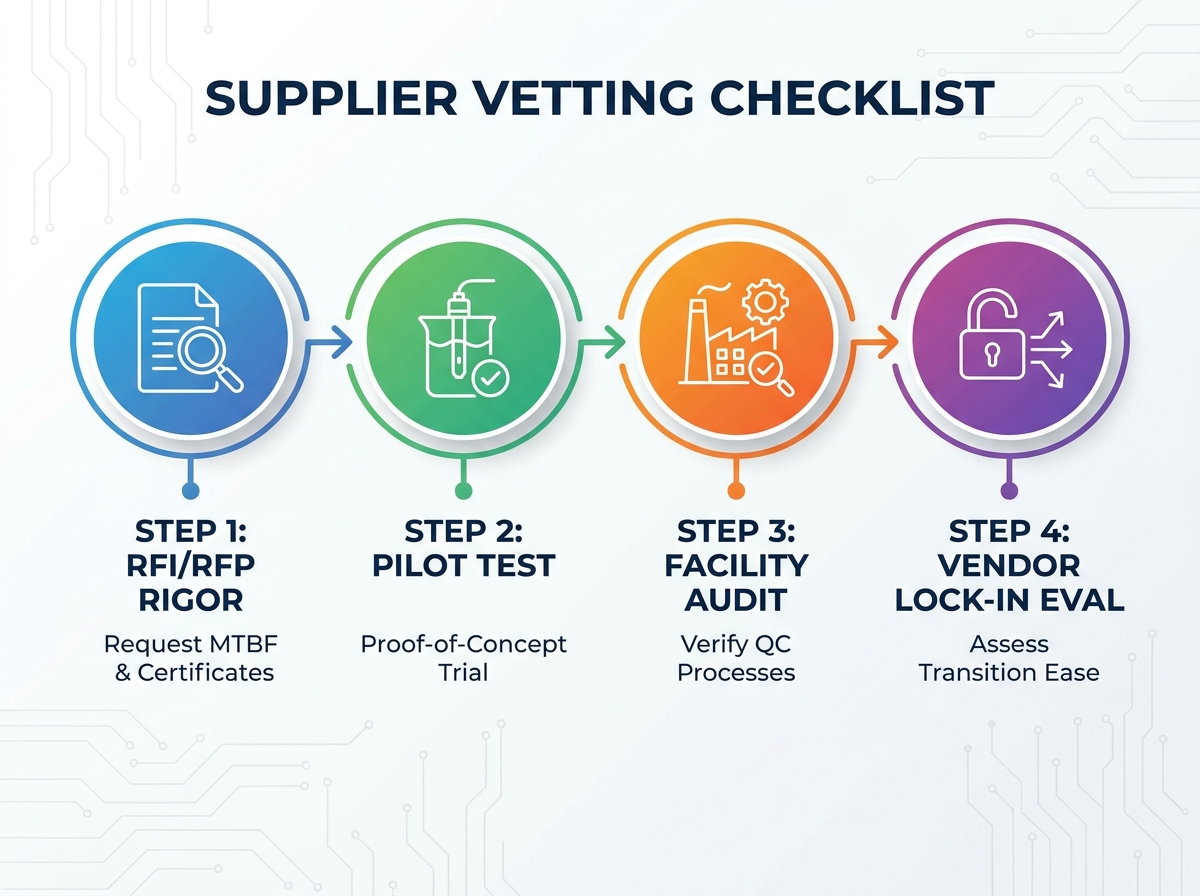
Use this structured, four-step approach to narrow down your options systematically.
Step 1: RFI/RFP Rigor. Request highly detailed technical documentation. Demand verified MTBF (Mean Time Between Failures) field data. Review their compliance certificates closely to ensure they remain current and valid.
Step 2: The Pilot Test. Mandate a rigorous proof-of-concept phase. Deploy sample sensors side-by-side with your existing equipment. Verify their accuracy, response times, and baseline drift claims in real-world conditions.
Step 3: Facility Audit. Audit their production floor if geographically feasible. Verify their quality control processes and calibration labs in person. Check their raw material inventory management practices to ensure supply stability.
Step 4: Vendor Lock-in Evaluation. Assess your long-term exit strategies. Can you transition away easily if their support degrades? Proprietary communication protocols trap you into buying their expensive controllers. Open standards offer necessary operational freedom.
Best Practice: Always assign a dedicated project engineer to oversee the pilot test phase. Their daily logs will provide objective data when comparing different manufacturers.
The best sensor on paper fails miserably without reliable manufacturer support. Poor internal quality control ruins even the most advanced engineering designs. Your critical operations depend entirely on consistent, predictable data streams.
Prioritize long-term field reliability over the lowest initial unit cost. Transparent compliance protocols protect your operations from severe regulatory backlash. A strong, responsive supplier acts as a strategic asset rather than a simple vendor.
Initiate your supplier vetting process today. Standardize an internal technical requirements document based on your specific environmental challenges. Hold your potential partners fully accountable to the rigorous standards outlined above.
A: Focus heavily on ISO 9001 for quality management systems. Look for CE and RoHS for electronic safety compliance. Depending on your industry, prioritize industry-specific approvals. These include EPA-approved methodologies for wastewater monitoring or NSF/ANSI 61 certifications for safe drinking water applications.
A: Lifespans vary wildly based on the specific application and chemical exposure. However, high-quality materials extend this significantly. Features like Teflon coatings, robust Titanium housings, and automatic wipers prevent biofouling. These engineering choices extend lifespan from mere months to several years.
A: Yes, top-tier manufacturers offer highly customizable firmware. They typically provide standard RS485 and Modbus RTU outputs. Their engineering teams can bridge complex integration gaps. This ensures modern digital sensors communicate flawlessly with older legacy SCADA infrastructure.
A: Industry standard warranties typically cover 12 months from the date of installation or 18 months from shipment. However, you must emphasize checking the exclusions. Warranties usually exclude consumable parts like membranes, reagents, and reference electrolytes degraded by normal industrial use.