
Views: 0 Author: Site Editor Publish Time: 2026-07-03 Origin: Site


Dissolved oxygen acts as the ultimate pulse in every commercial aquaculture operation. It dictates feed conversion ratios. It directly limits growth rates. It determines daily fish mortality. When oxygen levels drop, the entire farm experiences immediate physiological stress. Many facility operators mistakenly purchase standalone probes transactionally. This ad-hoc approach hides massive operational costs. Integration failures emerge without warning. Maintenance downtime spikes during critical harvesting windows. Automated aeration becomes erratic. You need a highly resilient strategy to secure your facility. Transitioning to a dedicated vendor relationship guarantees long-term reliability. A structured partnership ensures your hardware scales seamlessly. We will explore how choosing the correct partner transforms farm management. You will learn essential evaluation criteria. We will examine advanced sensor technologies. We also cover practical implementation strategies for modern smart farms.
Transitioning from transactional purchases to a strategic dissolved oxygen sensor supplier stabilizes long-term hardware availability and technical support.
Modern smart farms require sensors built on optical/fluorescence technology to minimize calibration drift and maintenance overhead.
Evaluating a supplier requires looking beyond upfront sensor cost to long-term operational value, including integration readiness, biofouling mitigation, and warranty terms.
Successful implementation demands rigorous pilot testing and a clear understanding of environmental limitations.
Inaccuracy carries a severe financial penalty in commercial fish farming. Drifting readings inevitably lead to chronic over-aeration. This operational flaw wastes massive amounts of electricity. Conversely, under-aeration stunts livestock yield. It leaves populations highly susceptible to rapid disease outbreaks. Strategic sourcing solves these costly fluctuations.
Standardizing a single aquaculture water sensor protocol changes everything. You can streamline operations across multiple open-air ponds. Recirculating Aquaculture Systems (RAS) benefit immensely from unified data. A dedicated partner provides predictable maintenance schedules. They offer guaranteed availability for replacement caps. You receive regular firmware updates automatically. Relying on gray-market or mixed-brand hardware creates absolute operational chaos. Managing fifty separate tanks requires uniform baseline data. Mixing different brands introduces conflicting calibration curves.
Strategic vendor relationships eliminate these dangerous blind spots. A unified approach ensures every automated aerator responds accurately. Facility managers spend less time troubleshooting mismatched protocols. They spend more time optimizing feed schedules. You effectively transform unpredictable hardware expenses into manageable operational investments. Consistent hardware behavior builds trust in your automated systems.
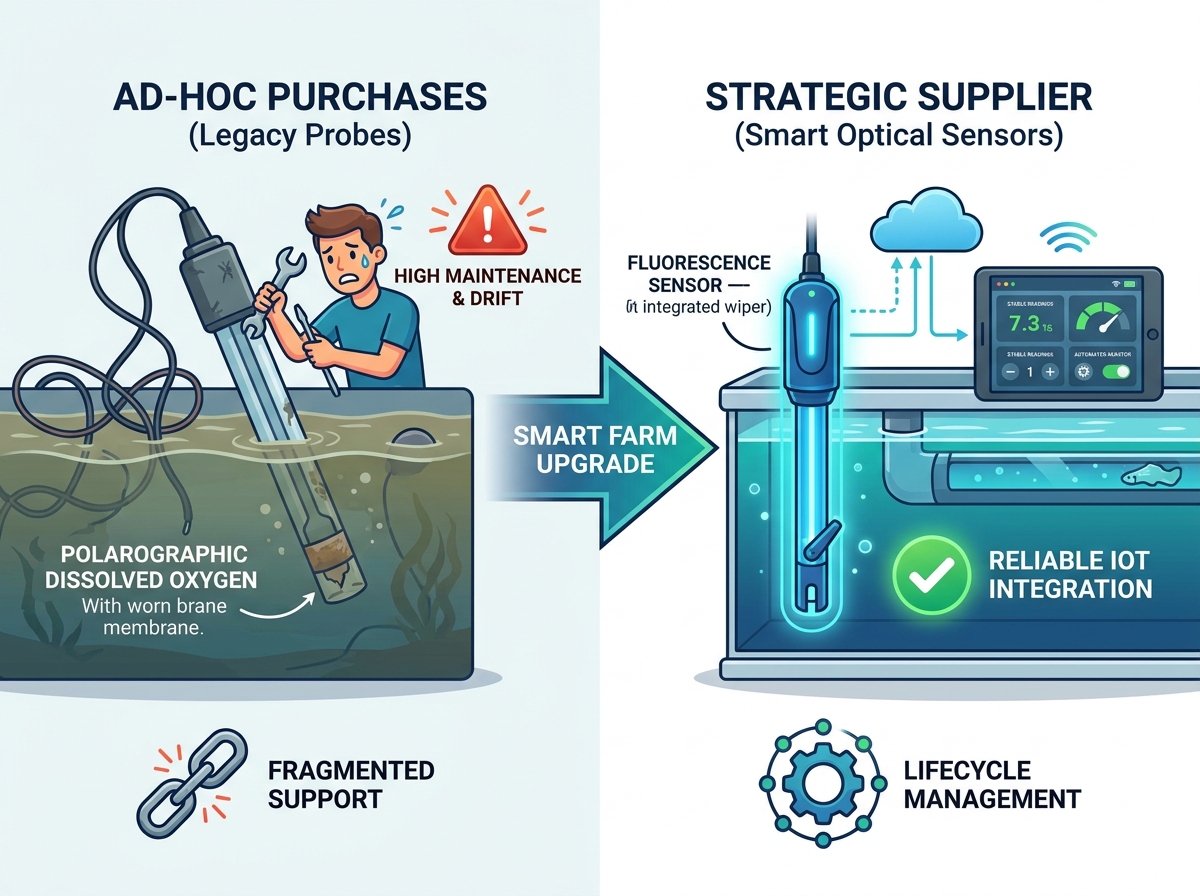
Legacy hardware struggles in demanding aquatic environments. Traditional galvanic and polarographic probes demand constant upkeep. They require frequent membrane replacements. They rely on constant water flow to read accurately. Bio-fouling quickly renders them useless in high-density tanks.
A fluorescence dissolved oxygen sensor solves these inherent flaws. Optical quenching physics drives this modern innovation. A specific blue light wavelength excites a specialized luminophore material. Oxygen molecules interact locally and quench this emitted red light. The sensor measures this precise phase shift. It consumes absolutely zero oxygen during measurement. It requires no water flow across the lens. This mechanism provides superior long-term stability in dense biomass environments.
Evaluating an optical do meter requires strict baseline expectations. You must verify rapid response times under changing temperatures. Ensure tight accuracy tolerances across varying salinity levels. Built-in temperature compensation remains non-negotiable for outdoor ponds. Sunlight and ambient weather shift water temperatures rapidly. The internal thermistor must react instantly to adjust the oxygen calculation.
Feature Comparison |
Legacy Electrochemical Probes |
Modern Optical Fluorescence |
|---|---|---|
Measurement Method |
Oxygen consumption (requires flow) |
Light phase shift (no flow needed) |
Maintenance Frequency |
High (Weekly membrane/electrolyte changes) |
Low (Annual cap replacement) |
Calibration Drift |
High (Susceptible to chemical interference) |
Very Low (Highly stable over months) |
Fouling Resistance |
Poor (Membrane clogs easily) |
Excellent (Often pairs with wipers) |
Finding the right dissolved oxygen sensor supplier takes strict diligence. You must assess integration readiness first. Look for flexible data output options. RS485 Modbus RTU, 4-20mA, and SDI-12 represent universal industry standards. These protocols ensure seamless connection to existing Programmable Logic Controllers (PLCs). They link effortlessly to modern SCADA systems and cloud-based dashboards.
Biofouling defense determines actual field longevity. Examine the physical hardware design closely. Barnacles and biofilms destroy sensor accuracy rapidly. Ask if the unit features integrated wiper systems. Copper-alloy guards effectively mitigate aggressive algae growth. They prevent bacterial colonies from blinding the sensitive luminophore cap. Active cleaning mechanisms drastically reduce manual labor hours.
Scalability remains crucial for any advanced fish farm monitoring sensor. Determine if the partner supports rapid operational expansion. You might start locally on a single raceway. Soon, you may need a multi-site monitoring network. The hardware ecosystem must accommodate hundreds of distinct data points seamlessly.
Supply chain logistics matter deeply. Analyze the availability of critical consumable parts. Luminophore caps need periodic replacement to maintain accuracy. Check typical delivery lead times. Confirm you have dedicated technical support access. A responsive engineering team prevents minor glitches from becoming catastrophic failures.
No monitoring equipment is entirely maintenance-free. Environmental constraints always apply. Set realistic expectations for periodic cleaning. High-fouling environments demand regular visual inspections. Suspended solids and heavy organic loads challenge even the best self-cleaning mechanisms.
Proper deployment dictates data accuracy. Follow strict installation best practices for your water do probe.
Submerge the unit strictly to the manufacturer's specified depth limits.
Mount the device at a 45-degree angle to prevent air bubbles from trapping on the cap.
Position the hardware far away from feeding zones to avoid localized oxygen spikes.
Secure all communication cables firmly in conduits to prevent damage from harvesting nets.
Keep the sensor away from the direct turbulence of paddlewheel aerators to prevent physical strikes.
Data redundancy protects your valuable livestock. Establish robust failsafes for any transmission loss. Automated aerators must default to a safe state. A disrupted connection between the network and controllers should trigger backup oxygenation immediately. Never let a broken cable suffocate your harvest.
A rigorous pilot testing framework prevents costly mistakes. We strongly recommend a 30-to-60-day parallel test. Compare the new unit against recognized laboratory titrations. Use known baselines like the Winkler method for verification. Run the pilot unit alongside your existing legacy probes. Observe the divergence in data over several weeks.
Ask key vendor questions before signing major procurement contracts.
What is the guaranteed lifespan of the optical cap in our specific salinity and turbidity conditions?
Are custom cable lengths and robust, waterproof marine connectors standard or custom-order?
What is the exact RMA (Return Merchandise Authorization) process for defective field units?
How quickly can your support team diagnose a Modbus communication error remotely?
Align your procurement timelines carefully. Match them up with planned facility upgrade schedules. Initiate vendor contact early for pilot units. Rushing a deployment often leads to poor cable management and integration errors.
A smart farm’s automated decisions rely entirely on accurate data. Poor sensor inputs inevitably lead to catastrophic mechanical responses. Choosing a dedicated supplier represents a major infrastructure decision. Integration compatibility heavily outweighs the initial unit price tag. Long-term lifecycle support secures your daily operations. Transitioning to advanced fluorescence technology stabilizes your monitoring network. You eliminate the constant burden of membrane replacements. Consult an applications engineer today. They will help spec the correct optical configuration for your unique water profile. Take action now to protect your livestock and optimize your energy consumption.
A: Modern optical sensors feature highly extended calibration intervals. They typically require calibration only every 6 to 12 months. This vastly outperforms traditional sensors. However, operators should perform periodic zero-point checks. Quick verification in saturated air or zero-oxygen solutions ensures ongoing accuracy.
A: An optical meter uses light-based measurement principles. It monitors the phase shift of red light caused by oxygen quenching. A polarographic probe relies on electrochemical measurement. It measures an electrical current across a permeable membrane. Optical sensors require drastically less maintenance and no water flow.
A: Yes. Most modern probes feature standard digital outputs like RS485 Modbus RTU. They also offer analog 4-20mA signals. These protocols act as a bridge. They connect advanced new sensors seamlessly with your facility's legacy control panels and PLCs.
A: Several factors cause premature failure. Cable water ingress remains a primary culprit. Severe biofouling without automated wiping mechanisms degrades performance rapidly. Physical strikes from aquatic life, paddlewheels, or harvesting machinery also destroy sensors. Proper mounting angles and protective guards prevent these common issues.


