Views: 0 Author: Site Editor Publish Time: 2026-07-04 Origin: Site

B2B procurement teams frequently encounter a persistent dilemma in fluid management. Plant managers must decide between repeatedly replacing degraded components or investing in a comprehensive, factory-engineered system. It forces operations to balance immediate budgets against long-term reliability.
Field engineers constantly voice frustrations over severe industry pain points. You often hear complaints about sudden signal drift in wastewater, rapid electrode poisoning, and endless calibration bottlenecks. These persistent measurement failures directly cause unplanned downtime and drain your maintenance resources. Relying on inadequate instruments creates hidden operational drains.
This article delivers a transparent, vendor-agnostic framework to evaluate your instrumentation options. You will discover exactly when to source standalone replacement probes for legacy systems. We also explore when you should partner with an integrated manufacturer for a complete sensing solution. You will gain actionable insights to upgrade your measurement loops confidently.
Standalone probes are consumable components suited for legacy system maintenance; factory-integrated sensor systems provide pre-calibrated, digital solutions with diagnostic capabilities.
Transitioning from analog probes to digital smart sensors reduces maintenance labor and limits signal interference in harsh environments.
Evaluating a solution requires assessing not just upfront unit cost, but MTBF (Mean Time Between Failures), calibration frequency, and integration compatibility.
Understanding the fundamental differences between components and systems ensures better procurement decisions. You must distinguish between raw sensing elements and complete analytical loops.
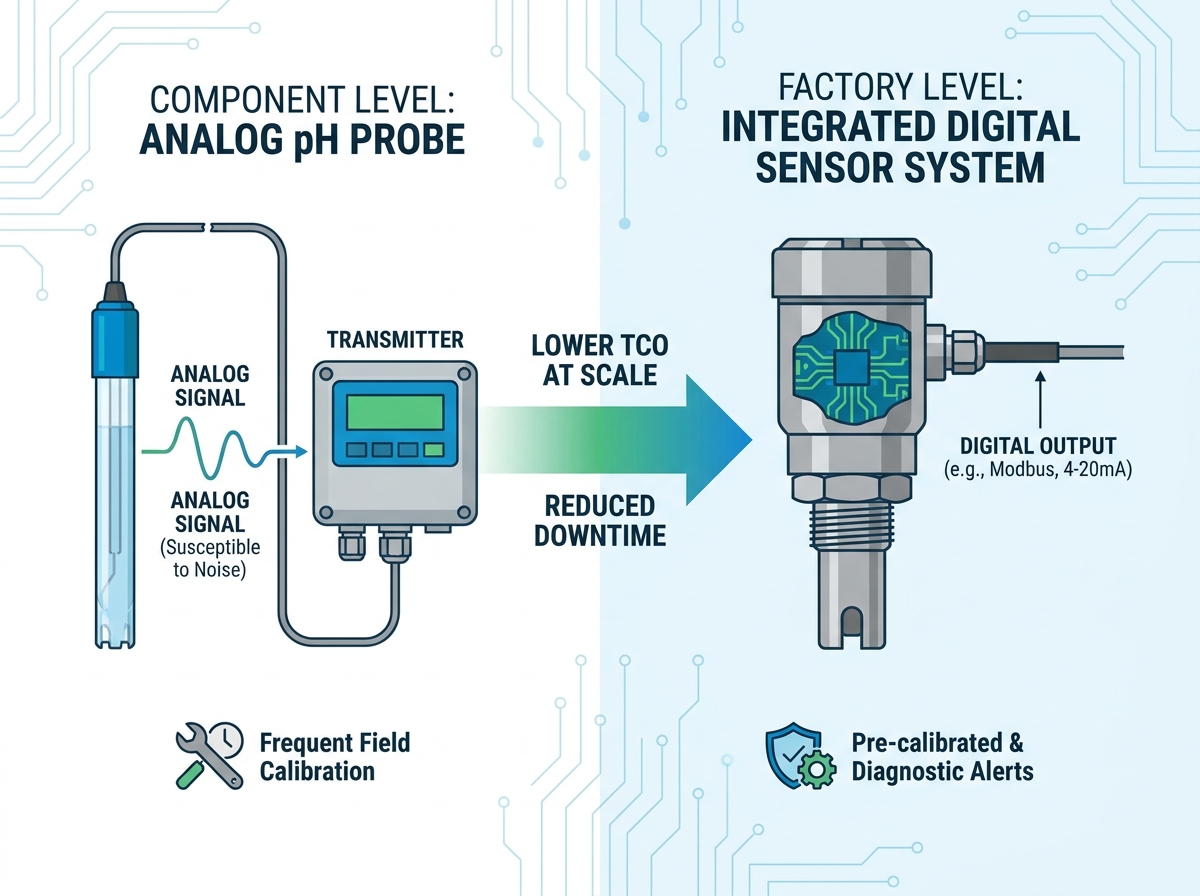
A standalone probe functions strictly as a raw consumable. It primarily consists of a sensitive glass bulb and a reference junction. These elements directly contact your process fluid. Most traditional probes utilize analog technology. They generate a weak, high-impedance millivolt signal. They require external transmitters to convert this raw signal into readable data.
These analog components serve specific operational needs. You should deploy them under particular conditions:
Performing quick, low-cost replacements in stable infrastructures.
Maintaining legacy analog systems without redesigning the panel.
Operating in clean, low-fouling environments where signal degradation remains minimal.
A basic water ph monitoring probe provides a straightforward measurement approach. However, it shifts the signal processing burden entirely to your external hardware.
An integrated sensor system represents a complete measurement loop. It combines the raw probe, internal transmitter, application-specific housing, and digital output into one unit. Manufacturers engineer these solutions at the factory level. They embed microprocessors directly inside the sensor head. This design frequently features built-in signal processing protocols like RS485 Modbus or 4-20mA.
A complete industrial ph sensor transforms how your facility manages analytical data. They fit best in demanding scenarios:
Integrating directly into modern SCADA architectures.
Upgrading harsh industrial processes requiring robust digital signals.
Scaling operations across multiple remote monitoring locations.
Choosing the correct measurement technology demands careful technical evaluation. You must analyze signal integrity, material durability, and diagnostic potential.
Analog probes exhibit significant high-impedance vulnerabilities. Their weak millivolt signals travel across exposed cables. They remain highly susceptible to moisture ingress. Electromagnetic noise from nearby motors often distorts analog readings. Long cable runs exacerbate these vulnerabilities significantly.
Factory-sealed digital sensors eliminate these high-impedance risks. They digitize the Nernst potential directly at the sensing head. This operational shift provides massive maintenance advantages. Digital sensors allow for lab-based calibration. Technicians can calibrate the unit offline and swap it instantly in the field. This workflow eliminates cumbersome field-based calibration in adverse weather conditions.
You must evaluate housing materials based strictly on your application media. Standard PVC bodies work exceptionally well for general water treatment. They offer excellent cost efficiency for municipal water. However, aggressive chemicals demand superior plastics. PPS or Ryton bodies provide robust chemical resistance against solvents and strong acids.
Extreme process conditions dictate metallic housings. High-temperature and high-pressure environments exceed plastic capabilities quickly. Hygienic food and beverage applications also require strict sanitation standards. In these demanding scenarios, a stainless steel ph sensor becomes mandatory. It ensures structural integrity and compliance.
Traditional "blind" probes only transmit a primary millivolt value. They offer no internal health data. You only discover a failure when the process drifts out of specification. This reactive approach guarantees eventual unplanned downtime.
Modern smart systems actively monitor their own condition. A comprehensive water quality ph analyzer offers predictive maintenance alerts. It tracks critical variables continuously. The system monitors glass impedance to detect bulb cracks. It checks reference junction resistance to identify clogging early. These diagnostics transform your maintenance strategy from reactive to proactive.
Analytical Comparison of Measurement Approaches
Capability Dimension | Analog Probes | Integrated Digital Sensors |
|---|---|---|
Signal Type | High-impedance Millivolt | RS485 Modbus / 4-20mA |
Calibration Location | Field only (requires transmitter) | Lab-calibrated (pre-stored data) |
Diagnostic Alerts | None (Blind output) | Impedance & Clogging Alerts |
Cable Vulnerability | High (Moisture & EMI sensitivity) | Low (Robust digital transmission) |
Field installations reveal the actual performance limitations of analytical instruments. You must anticipate aggressive media, installation hurdles, and false economies.
Low-cost off-the-shelf probes often present a dangerous false economy. Procurement might celebrate initial savings. However, aggressive media quickly expose inferior designs. Wastewater scaling coats basic glass bulbs rapidly. This forces your team into frequent recalibration cycles. High labor costs rapidly consume any initial purchase savings. Short lifespans in demanding processes turn cheap components into expensive liabilities.
You must outline realistic expectations for sensor lifespans. Heavy metals and high-sulfide environments destroy standard reference junctions. Sulfides react with silver chloride to form insoluble precipitates. This process clogs the reference pathway permanently.
Engineers must deploy advanced designs against poisoning. Double-junction references isolate the primary silver element from process sulfides. Solid-state reference designs prevent process fluid ingress entirely. These robust designs prevent premature electrode death.
Physical integration frequently presents unforeseen engineering challenges. Retrofitting an online ph electrode into existing pipelines requires careful planning. You must choose between inline insertion and submersion mounting.
Inline installations might require specialized retraction assemblies. Submersion mounts need proper structural support against flow turbulence. Some applications mandate flow-through cells to maintain optimal sample velocity. Ignoring these fluid dynamics guarantees erratic readings.
Your procurement channel dictates your long-term operational success. Buying singular units from generic distributors works for small facilities. Large-scale operations require strategic manufacturing partnerships.
Distributor catalogs lack flexibility. They offer rigid configurations. Buying through intermediaries becomes highly inefficient at scale. OEM and ODM factories provide necessary agility. They manufacture customized form factors for unique pipe diameters. They supply specific cable lengths to eliminate messy junction boxes. They even formulate tailored reference gels designed specifically for your chemical media.
Relying on fragmented distributors introduces massive supply chain risks. Legacy components get discontinued without warning. This leaves your facility scrambling for alternatives. Direct partnerships secure your supply line. An integrated factory ensures consistent batch-to-batch accuracy over decades. You lock in your component availability through long-term agreements.
Transactional probe purchases rarely include engineering guidance. Distributors ship boxes and close tickets. Partnering directly with an industrial water ph sensor factory unlocks critical technical support. Factory engineers perform fluid dynamics analysis prior to your installation. They validate your mounting strategy. Factory-backed warranties cover actual industrial application failures rather than just manufacturing defects.
Moving from evaluation to procurement requires a systematic approach. Follow this structured logic to specify your ideal measurement loop.
Audit the Environment: Document your exact process conditions. Record maximum temperature spikes and peak pressure limits. Detail the specific chemical composition and abrasive particulate levels.
Assess Existing Infrastructure: Inspect your current control panels. Determine if your PLCs mandate analog inputs. Check if your controllers can accept digital RS485 protocols.
Calculate Lifecycle Value: Build a comprehensive formula. Factor in the initial unit cost. Add your estimated installation labor. Integrate the expected lifespan based on media harshness. Finally, calculate recalibration labor hours over the instrument's life.
Request Proof of Concept: Never deploy unproven technology across a facility. Advise your team to request trial units first. Run a 30-day side-by-side test in the actual process fluid. Prove stability before initiating a mass rollout.
Upgrading from a basic consumable approach to a system-level strategy delivers massive operational benefits. Smart architectures drastically reduce unplanned downtime. They eliminate frustrating field calibrations and mitigate signal interference permanently.
We recommend defaulting to standalone components only for exact replacements in legacy systems. You should aggressively shift toward factory-direct digital sensor architectures for all new builds. High-fouling environments demand integrated solutions immediately. Audit your worst-performing measurement loop today. Request a digital trial unit to prove the stability gains firsthand.
A: Lifespans vary dramatically based on application media. You can expect 6 to 12 months of reliable service in harsh wastewater applications. Clean water processes often allow sensors to survive up to 2 or 3 years. Proper cleaning protocols and routine maintenance significantly extend these timelines.
A: Constant drifting usually stems from three main culprits. Ground loop interference frequently disrupts weak analog signals. Process contaminants might be clogging your porous reference junction. Alternatively, the internal electrolyte could simply be depleted. Digital isolation usually resolves ground loop issues.
A: No. A digital format does not repeal the laws of chemistry. It greatly reduces calibration frequency and allows convenient off-site lab calibration. However, physical glass wear and reference aging still occur. You must perform periodic standard buffer checks to verify absolute accuracy.
A: You must specify stainless steel when process temperatures exceed 100°C or pressures surpass standard plastic ratings. Additionally, hygienic environments require steel. Food, beverage, and pharmaceutical facilities demand electropolished stainless steel to meet strict sanitation and Clean-In-Place (CIP) standards.