
Views: 0 Author: Site Editor Publish Time: 2025-12-17 Origin: Site

Chemical Oxygen Demand (COD) monitoring is a key component of effective wastewater management. COD measures the amount of oxygen required to oxidize the organic material in wastewater. This measurement serves as a crucial indicator of water quality, as it helps determine the pollution load in water, which is essential for assessing the degree of contamination. Monitoring COD levels regularly is essential for ensuring that wastewater treatment processes are working effectively and that treated water meets the necessary environmental standards before being discharged.
The growing need for continuous and accurate COD monitoring, especially in industries such as manufacturing, chemical processing, and municipal wastewater management, has led to advancements in sensor technology. Traditional methods of COD testing were often time-consuming and resource-intensive, but recent innovations in optical absorption sensor technology have revolutionized how COD is monitored. These advancements make it possible to continuously track COD levels in real-time with improved accuracy, less maintenance, and lower operational costs.
With the increase in remote locations and off-grid sites requiring continuous water quality monitoring, the demand for long-term, low-power COD monitoring solutions has never been greater. Traditional COD testing methods, which require regular manual sample collection and laboratory analysis, are costly and not suitable for long-term, real-time monitoring, especially in remote locations.
Recent advancements in sensor technology, specifically optical absorption sensors, are addressing these challenges by offering low-power, long-lasting solutions for continuous COD monitoring. These sensors can operate on battery power or solar energy, making them ideal for remote applications or areas where access to electricity is limited. Furthermore, optical absorption sensors have become more energy-efficient, reducing the operational costs associated with long-term monitoring.
Traditional methods for measuring COD include chemical tests, such as the closed reflux method, and colorimetric analysis, which require adding reagents to water samples and heating them to measure the oxygen demand. These tests are typically performed in a laboratory setting, and while they are considered reliable, they are time-consuming, labor-intensive, and costly. The process of preparing reagents, heating samples, and conducting the necessary steps to measure COD can take hours to complete, making it impractical for real-time monitoring.
Additionally, traditional COD tests require significant amounts of chemicals, which generate waste and can have negative environmental impacts. The need for reagents also introduces the risk of human error, which can affect the reliability of results. These limitations make traditional methods unsuitable for continuous, long-term monitoring of COD levels.
The key limitations of traditional COD testing methods include:
Time-Consuming: These methods take several hours to complete and are not suitable for real-time monitoring.
Chemical Handling: The need for hazardous chemicals and reagents increases operational costs and creates environmental waste.
Labor-Intensive: Traditional methods require frequent manual intervention, leading to higher labor costs.
Limited Sensitivity and Range: Traditional tests may not provide the level of detail required for fine-tuned process control or regulatory compliance in real time.
As a result, industries are increasingly looking for automated, continuous, and low-maintenance solutions for monitoring COD levels.
Optical absorption technology is a method used to measure COD by detecting the absorption of light in the ultraviolet (UV) spectrum. In this method, a sample of wastewater is exposed to UV light, typically at a wavelength of 254 nm, which is absorbed by organic compounds in the water. The amount of light absorbed correlates directly with the COD level, allowing for accurate measurement.
The sensor uses a photodetector to measure the intensity of transmitted light and calculates the concentration of organic materials based on the observed absorption. This non-invasive and real-time measurement provides immediate feedback on water quality, making it a valuable tool for continuous monitoring.
Recent innovations in optical absorption sensor technology have significantly improved their performance, making them more reliable, efficient, and suitable for long-term, low-power operation.
Innovation | Description |
Miniaturization of Sensors | Modern sensors are smaller and more compact, allowing for easier installation in various environments without compromising performance. |
Energy-Efficient Components | New components, including low-power LEDs and photodetectors, reduce energy consumption, extending sensor battery life and minimizing maintenance. |
Improved Sensitivity and Accuracy | Advances in sensor technology have led to higher sensitivity, enabling precise detection of small changes in COD levels, even in low-concentration samples. |
Self-Cleaning Mechanisms | To maintain optimal performance, many modern COD sensors feature automatic cleaning systems that prevent fouling and buildup of contaminants. |
Integration with IoT | Sensors now come with built-in connectivity features, enabling remote monitoring and data collection, enhancing user experience and operational control. |
These innovations make optical absorption COD sensors ideal for industries that require long-term, continuous monitoring while maintaining low operational costs.
The primary benefit of optical absorption sensors is their ability to operate efficiently over extended periods while consuming minimal power. Traditional COD measurement methods are power-hungry, requiring significant amounts of energy to heat samples and operate laboratory equipment. Optical absorption sensors, however, utilize low-energy LEDs that emit UV light, drastically reducing power consumption compared to older methods.
Low-power design is essential for applications that require sensors to operate for months or years without frequent battery replacements or recharging. By employing energy-efficient components, manufacturers have developed sensors capable of functioning in remote locations where power sources are scarce, such as rivers, lakes, and offshore facilities.
Many modern COD sensors are equipped with energy-efficient components that allow them to operate for extended periods on battery power alone. Some sensors also feature solar panels, which provide continuous power in outdoor settings, making them perfect for long-term, off-grid installations. Solar-powered COD sensors can be deployed in areas with limited access to electrical infrastructure, where traditional sensors would require costly infrastructure setup.
Power Option | Benefit |
Battery-Powered Sensors | Provide long-lasting, low-power operation with minimal need for maintenance. Batteries can last for months, depending on usage and environmental conditions. |
Solar-Powered Sensors | Perfect for outdoor, remote locations; solar panels provide continuous power without the need for external electrical connections. |
Advancements in wireless communication technologies, such as IoT, Wi-Fi, and Bluetooth, have further reduced the need for manual intervention in COD monitoring. Modern optical absorption sensors can transmit data remotely to centralized monitoring systems or cloud-based platforms, enabling real-time access to water quality data from anywhere.
Wireless data transmission not only minimizes power consumption associated with data logging and reporting but also allows operators to receive alerts when COD levels exceed preset thresholds, reducing the likelihood of missed incidents and facilitating prompt action.
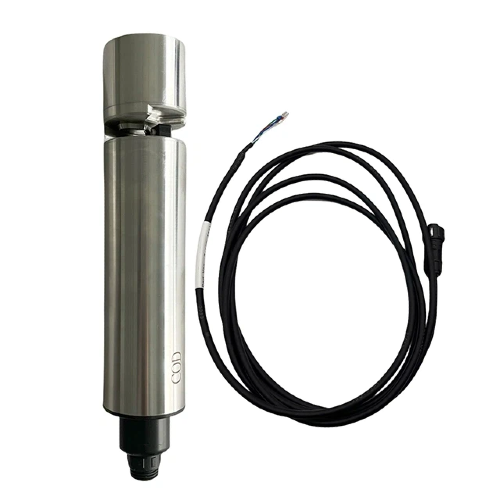
The primary advantage of using long-term, low-power COD sensors is cost reduction. Traditional COD tests require manual labor, reagents, and significant energy to process samples. Optical absorption sensors, on the other hand, reduce the need for reagents and minimize labor costs. Furthermore, their energy-efficient design leads to substantial savings in operational costs, particularly when deployed in remote or off-grid areas.
The low-maintenance nature of these sensors also reduces downtime and service costs. Self-cleaning mechanisms, combined with reliable, long-lasting power sources, ensure continuous operation for extended periods without requiring frequent maintenance.
Optical absorption COD sensors are not only cost-effective but also environmentally friendly. The reduction in reagent use means less chemical waste, which is a significant environmental benefit. Additionally, the low power consumption minimizes the carbon footprint of the monitoring system, supporting sustainability initiatives across industries.
By adopting low-power sensors, companies can meet both operational and environmental goals, contributing to a greener, more sustainable future.
One of the key advantages of long-term, low-power COD sensors is their ability to be deployed in locations without access to traditional power sources. Whether it’s a remote river monitoring station or a wastewater treatment facility in an industrial area, these sensors can be installed and left to run with minimal human intervention.
Because of their portability and ability to operate independently, they are also ideal for temporary setups or areas where other types of monitoring equipment would be impractical.
As sensor technology continues to advance, we are seeing the miniaturization of COD sensors, making them smaller and more flexible. This trend opens up possibilities for portable, wearable COD sensors that can be used in field testing and mobile applications. These sensors could potentially be integrated into portable monitoring kits, providing quick and easy COD readings in the field.
The future of COD sensors lies in their integration with AI and data analytics platforms. By incorporating machine learning algorithms, COD sensors can become more intelligent, providing predictive insights and pattern recognition. This will allow operators to anticipate water quality issues before they become critical, optimizing the wastewater treatment process and improving overall efficiency.
As the demand for durable, long-lasting sensors increases, we are likely to see further enhancements in sensor resilience, including the ability to withstand harsh environmental conditions. Future sensors may also incorporate smart features such as self-diagnostics, remote calibration, and predictive maintenance alerts to enhance the user experience.
Long-term, low-power COD monitoring is becoming a vital component in modern wastewater management, enabling industries to continuously monitor water quality while minimizing operational costs. Optical absorption sensor technology has transformed COD measurement, offering higher accuracy, greater efficiency, and more sustainable solutions. By adopting these advanced sensors, industries can not only meet stringent regulatory requirements but also significantly reduce their environmental impact, enhancing overall operational efficiency. As sensor technology continues to progress, further innovations will undoubtedly improve water quality monitoring, making it smarter, more efficient, and environmentally friendly.
At Beijing Leadmed Technology Co., Ltd., we specialize in providing cutting-edge, low-power COD sensors designed to meet the evolving needs of industries worldwide. Our sensors offer reliable, real-time data, helping you optimize wastewater treatment processes while ensuring compliance with environmental standards. Contact us today to learn more about how our advanced solutions can support your wastewater management goals and contribute to your sustainability efforts.
An optical absorption sensor measures the absorption of UV light in a water sample. Organic compounds in the water absorb UV light at specific wavelengths, and the sensor calculates the COD level based on the amount of light absorbed.
Low-power COD sensors provide continuous monitoring with minimal energy consumption, reducing operational costs. They also eliminate the need for reagents and manual sampling, making them more efficient and environmentally friendly.
Yes, optical absorption COD sensors are designed to operate in challenging environments, such as extreme temperatures or high-turbidity water. Many modern sensors are built to be durable and weather-resistant.
The battery life of a low-power COD sensor can vary, but many sensors are designed to last for months on a single charge, depending on usage and environmental conditions.
AI integration in COD sensors enables predictive maintenance, pattern recognition, and smarter data analysis. It allows for early detection of water quality issues, improving the decision-making process for wastewater treatment.


