
Views: 0 Author: Site Editor Publish Time: 2026-04-23 Origin: Site
In industrial wastewater treatment, sensor selection is rarely a small technical detail. It affects data reliability, maintenance frequency, process control stability, and even compliance confidence. When we help customers evaluate online monitoring solutions, one of the most common questions is whether a flow cell or an immersion probe is the better choice. The answer is not universal, because industrial wastewater conditions vary widely from plant to plant.
We usually see this choice come down to a practical balance between sample control and installation simplicity. Both configurations can support accurate measurement of key parameters such as pH, ORP, conductivity, dissolved oxygen, turbidity, or residual chlorine, but they interact with wastewater differently. In real operating environments, factors like suspended solids, chemical dosing, flow variability, temperature swings, and cleaning access matter just as much as sensor specifications.
Industrial wastewater is not a uniform medium. It may contain abrasive particles, oil residues, unstable pH, organic matter, surfactants, corrosive chemicals, or intermittent discharge loads. Under such conditions, sensor performance depends not only on the probe itself, but also on how the probe is exposed to the water.
A well-chosen configuration can help operators reduce fouling, improve response consistency, and simplify maintenance planning. A poor choice can create unstable readings, excessive cleaning work, or misleading data during critical process adjustments. That is why comparing flow cell vs. immersion probes is not just about hardware format. It is about how to build a monitoring point that actually works under industrial stress.
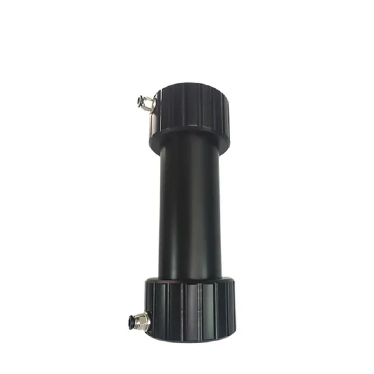
A flow cell is a chamber through which wastewater or a conditioned sample stream passes before contacting the sensor. The probe is installed inside this controlled chamber, allowing the sample to move across the sensing surface at a defined rate.
In many systems, the sample reaching the flow cell may first pass through pretreatment steps such as filtration, pressure reduction, degassing, or temperature moderation. This creates a more controlled measuring environment and can improve the consistency of certain analytical measurements. Flow cells are especially valuable when the raw wastewater stream is too aggressive, too turbulent, or too variable for direct probe placement.
An immersion probe is installed directly into the tank, channel, pipeline, basin, or sump where wastewater is present. Instead of drawing the sample to the sensor, the sensor is placed directly into the process.
This approach is often preferred for its mechanical simplicity and lower auxiliary equipment needs. There is no separate sampling loop in the basic arrangement, and installation can be relatively straightforward. For continuous process observation, especially in larger tanks or open channels, immersion probes are often an efficient solution. However, they must tolerate whatever the process presents, including solids, coatings, turbulence, and inconsistent flow patterns.
Before selecting one over the other, it helps to compare their practical characteristics side by side.
Comparison Factor | Flow Cell | Immersion Probe |
Measurement environment | Controlled sample chamber | Direct exposure to process water |
Installation complexity | Higher, may require sample line and fittings | Lower, usually direct mounting |
Resistance to turbulence | Better controlled | Depends on process conditions |
Suitability for harsh solids | Better if paired with pretreatment | Can foul faster in dirty streams |
Maintenance access | Often easier in a service panel or skid | May require tank-side access or lifting assembly |
Real-time process representation | Slight delay possible due to sample transport | Immediate contact with process |
Water consumption | May require continuous sample flow | No separate sample consumption in basic use |
Best fit | Conditioned sampling, stable analysis | Direct process monitoring, simpler layouts |
Some industrial wastewater streams change rapidly in composition due to batch discharge, cleaning cycles, or chemical dosing events. In those cases, a flow cell can help create a more stable measuring environment. If the sample is conditioned before reaching the sensor, the data becomes easier to interpret and less vulnerable to hydraulic disturbance.
Wastewater with heavy suspended solids, grease, fibers, or abrasive content can shorten sensor life. A flow cell system can reduce direct exposure if upstream filtration or sample conditioning is used. This is often valuable in chemical plants, electroplating lines, textile wastewater, food processing discharge, and other difficult industrial applications.
In many projects, operators prefer maintaining sensors in a cabinet, panel, or monitoring skid instead of leaning over a channel or opening a tank cover. Flow cell arrangements often make sensor removal, calibration, and inspection more convenient, especially when access at the process point is limited.
Certain analytical parameters benefit from a stable flow profile around the sensor. A flow cell can reduce the effect of random splashing, dead zones, air bubbles, and uneven contact conditions. For plants focused on repeatability and trend reliability, this controlled environment can be a strong advantage.
Immersion probes are attractive because they reduce system complexity. There is no need for a separate sample pump or flow-regulating chamber in many cases. That means fewer components, lower installation effort, and less auxiliary piping. For straightforward treatment processes, this simplicity is often a major benefit.
Because the probe sits in the wastewater itself, immersion measurement reflects the process without sampling delay. This can be useful in aeration basins, equalization tanks, neutralization tanks, and outlet channels where the immediate state of the water is important for control decisions.
In some projects, operators need a practical monitoring point without building a full sampling system. Immersion probes can often meet this requirement more economically. They are especially useful where plant layout is tight and the installation team wants a fast deployment path.
If the wastewater does not contain excessive fouling components, or if automatic cleaning devices are included, immersion probes can run effectively for long periods. In moderate-duty environments, they can provide a strong balance of performance and operational convenience.
In industrial wastewater monitoring, fouling changes everything. A theoretically suitable probe can become unreliable very quickly if the sensing surface accumulates sludge, scale, oil film, or biological deposits.
Flow cells can reduce fouling risk when combined with sample conditioning, but they are not immune. If the sample line clogs or the chamber design traps solids, maintenance problems can simply shift from the basin to the sample system. Immersion probes face fouling more directly, but with proper mounting position, cleaning cycles, and protective accessories, they can still perform well.
We usually encourage users to think beyond the first installation. The more important question is: Which system will still deliver dependable readings after weeks or months in the actual wastewater environment? That is often where the better choice becomes clear.
From a lifecycle perspective, maintenance strategy matters as much as measurement accuracy. A configuration that saves time during weekly service can lower total operating cost significantly.
Flow cells often make calibration and inspection easier because the sensors are mounted in a more accessible area. Technicians can work in a controlled setting, which reduces downtime and improves maintenance quality. On the other hand, the system may include additional parts such as sample tubing, valves, or pumps that also require attention.
Immersion probes reduce peripheral hardware, but servicing them can be less convenient depending on where they are installed. If the probe is deep in a tank or exposed to corrosive fumes, routine calibration may take more effort. In dirty wastewater, cleaning frequency can also be higher unless automated cleaning is designed into the system.
The most honest answer is that neither flow cells nor immersion probes are universally better. The better option depends on the wastewater characteristics, the measurement target, the maintenance resources available, and the plant’s control priorities.
A flow cell is often better when:
the wastewater is harsh or unstable,
sample conditioning is needed,
maintenance access must be improved,
and measurement stability is more important than the most direct in-tank exposure.
An immersion probe is often better when:
the process benefits from direct real-time measurement,
installation simplicity is important,
the wastewater is manageable,
and the project needs a more compact or cost-conscious design.
In many industrial environments, the right solution is not chosen by theory alone. It is chosen by matching the measuring configuration to the actual working conditions, service habits, and process expectations.
When we evaluate sensor configuration for industrial wastewater, we usually begin with five practical questions:
What is the fouling level of the wastewater?
Does the application need a conditioned sample?
How easy is it to access the installation point safely?
How often can the operator realistically clean and calibrate the sensor?
Is immediate in-process response more important than measurement stability in a controlled chamber?
These questions often lead to a more useful conclusion than simply comparing product catalogs. Industrial wastewater systems are complex, and the best monitoring setup is the one that remains reliable under real plant conditions, not just under ideal laboratory assumptions.
The discussion around Flow Cell vs. Immersion Probes is ultimately about application fit. Flow cells offer a more controlled measuring environment and are often better for harsh, variable, or fouling-prone industrial wastewater. Immersion probes provide direct in-process monitoring and are often preferred for simpler installation and faster response.
From our perspective, the better choice depends on wastewater characteristics, maintenance conditions, and process control goals. A practical evaluation of fouling risk, service access, and measurement needs usually leads to the right decision. For readers who want to explore suitable monitoring solutions for industrial wastewater in more detail, we recommend learning more from Beijing Leadmed Technology Co., Ltd. or contacting the company for further support.
Q: What is the difference between a flow cell and an immersion probe?
A: A flow cell measures wastewater in a controlled chamber, while an immersion probe measures directly inside the process tank or channel.
Q: Which is better for industrial wastewater with heavy fouling?
A: A flow cell is often better because it can work with sample conditioning and may reduce direct sensor fouling.
Q: Are immersion probes easier to install?
A: Yes. Immersion probes usually have a simpler structure and need fewer extra components than flow cell systems.
Q: How do we choose between flow cell vs. immersion probes?
A: The choice depends on wastewater quality, fouling level, maintenance access, and whether stable measurement or direct real-time monitoring is more important.


