Views: 0 Author: Site Editor Publish Time: 2026-06-02 Origin: Site

Modern environmental monitoring and compliance require moving lab-grade accuracy directly to the testing site. Single-parameter tools are increasingly being replaced to minimize field time, reduce human error, and consolidate data management. Field engineers and environmental technicians face constant challenges with equipment durability and calibration drift. They also handle the logistical burden of managing multiple meters in harsh conditions. Heavy rain, high humidity, and variable temperatures easily compromise basic electronics, leading to unusable data and wasted trips.
This guide breaks down the underlying sensor technologies and evaluation criteria for rugged environments. We cover industry-standard deployment practices, including detailed USGS calibration protocols. You will learn how to configure a reliable, defensible water quality testing system. By understanding exactly how these smart instruments work, you can eliminate equipment redundancy. We will show you how to capture accurate, compliant data regardless of your sampling environment.
Consolidated Efficiency: Transitioning to a multiparameter water quality sensor reduces field deployment time and standardizes GLP (Good Laboratory Practice) data logging.
Sensor Reliability: Optical technologies (like luminescence-based DO) and smart, field-replaceable probes significantly reduce maintenance overhead compared to legacy electrochemical cells.
Defensible Data: Adherence to authoritative stabilization criteria and ordered calibration routines prevents cross-contamination and ensures regulatory compliance.
Modular Procurement: Purchasing is best approached as a 5-step modular build: Meter, Cable, Smart Sensors, Calibration Standards, and Field Accessories.
Moving away from legacy, single-parameter devices changes how environmental teams operate. You eliminate severe equipment redundancy instantly. Field crews no longer need to carry separate pH, conductivity, and dissolved oxygen meters. Instead, they use a single, multi-port device. This integration simplifies packing lists and reduces the physical burden on technicians hiking into remote sites. You only monitor one battery level and manage one digital interface.
Accelerating field operations is a massive operational benefit. Bringing benchtop capabilities directly to the field significantly reduces sample degradation risks. You no longer worry about temperature changes altering chemical compositions during transport. Consolidating your tools cuts testing time dramatically. Teams often report a 50% reduction in deployment time compared to managing individual probes. They drop one sonde into the water, wait for thermal equilibrium, and capture all data simultaneously.
Data integrity improves significantly when using a Multiparameter Water Quality Sensor. Automated data logging eliminates manual transcription errors. Devices automatically attach time, date, and GPS stamps to every reading. You build an unbreakable chain of custody for GLP (Good Laboratory Practice) compliance. Furthermore, modern smart sensors retain their own calibration data. You can seamlessly swap probes across different meters without losing accuracy. This prevents costly downtime if a handheld meter breaks, as you simply plug the calibrated sensor into a backup unit.
Understanding sensor mechanics ensures you select the right tool for your specific water matrix. Modern probes rely on distinct physical and chemical principles to capture environmental data.
A modern Water pH Sensor utilizes traditional glass electrodes or ISFET (Ion-Sensitive Field-Effect Transistor) technology. They measure hydrogen-ion activity to determine acidity or alkalinity. ORP measures the water's ability to break down waste products.
Evaluation Note: Always look for integrated temperature compensation. Temperature directly affects pH readings. You should also source probes with field-replaceable, gel-filled reference junctions. These prevent reference contamination in highly turbid waters.
You generally choose between two dissolved oxygen measurement principles: Optical (Luminescence/Fluorescence) and Galvanic/Clark Cell.
Evaluation Note: An optical Dissolved Oxygen Sensor represents the current industry standard. These optical systems do not consume oxygen during measurement. They require no warm-up time and remain immune to flow dependence. You do not need to stir the water to get an accurate reading. They also require minimal membrane maintenance compared to older galvanic cells.
A Water Turbidity Sensor assesses water clarity. The core principle relies on Nephelometric 90-degree light scattering. The sensor emits a light beam and measures how much light scatters off suspended particles at a 90-degree angle. This complies with strict ISO or EPA reporting standards.
Evaluation Note: Turbidity is critical for assessing suspended solids. If you test in heavily particulate environments, your sensor must have a built-in wiper mechanism. Anti-fouling guards also prevent algae and mud from blinding the optical lens.
Not all parameters require dedicated physical sensors. We mathematically derive Specific Conductance (SC), Salinity, and Total Dissolved Solids (TDS). The instrument uses basic Electrical Conductivity and Temperature readings to calculate these values.
Evaluation Note: Ensure your meter's firmware uses compliant conversion algorithms. Different regulatory bodies require specific constants to convert conductivity into TDS or Salinity. You must match the algorithm to your regional industry standard.
Sensor Technology Comparison Chart | ||
Parameter | Primary Technology | Key Field Advantage |
|---|---|---|
pH / ORP | Glass Electrode / ISFET | High precision; replaceable reference junctions extend lifespan. |
Dissolved Oxygen | Optical Luminescence | No flow required; holds calibration longer; zero warm-up time. |
Turbidity | 90-Degree Light Scattering | Directly correlates to suspended solids; supports self-cleaning wipers. |
Conductivity | 4-Electrode Cell | Resists polarization and fouling; calculates Salinity and TDS easily. |
Field instruments must endure severe abuse. Evaluating hardware ruggedness prevents catastrophic failures during critical sampling missions.
Ingress Protection (IP Ratings): High moisture environments destroy standard electronics. The baseline expectation for field instruments is an IP67 waterproof rating for the handheld meter. It must survive temporary submersion. You need an IP68 waterproof rating for the probes and cables, ensuring they withstand continuous underwater deployment.
Build Materials & Durability: Assess probe construction carefully. Plastics crack under pressure or degrade in harsh UV light. Titanium-welded bodies offer superior corrosion resistance. They perform exceptionally well in estuarine and marine applications where saltwater aggressively attacks standard metals.
User Experience (UX) in Harsh Conditions: Operating a device in freezing rain requires intuitive design.
Color-coded, field-replaceable sensors: This design reduces downtime dramatically. It prevents port mismatch errors when technicians swap probes with cold, gloved hands.
Cable Management: Look for single, multi-strand shielded cables. Suppliers offer them from 4 meters up to 100 meters. Quick-connect DIN connectors prevent water intrusion at the attachment point.
Power & Memory: Your device must support high-capacity data storage. Aim for meters holding more than 100,000 data sets. Long battery life is non-negotiable. Look for lithium-ion systems or standard AA battery options to provide remote redundancy when you lack charging access.
Using a premium Portable Water Quality Sensor requires rigorous procedural discipline. Adhering to authoritative frameworks, such as the U.S. Geological Survey (USGS) protocols, guarantees defensible data.
You must calibrate sensors in a specific order to prevent cross-contamination. Calibrating in order of increasing ionic strength stops highly concentrated solutions from contaminating lower concentration standards. Strictly follow this authoritative sequence:
Temperature (Verify against an NIST-traceable thermometer)
Specific Conductance (SC)
pH
Dissolved Oxygen
Oxidation-Reduction Potential (ORP)
Turbidity
Rinsing Rule: Probes must be rinsed meticulously. Use Deionized Water (DIW) to rinse the probe at least three times between different calibration standards. Blot them dry gently with a lint-free cloth to avoid diluting the next buffer.
Temperature dictates the accuracy of nearly every other parameter. When deploying a sonde in surface or groundwater, you cannot log data immediately. Allow at least 60 seconds of submersion for the sensors to reach thermal equilibrium. Cold groundwater takes time to cool the physical mass of the sensor body. Premature logging guarantees flawed pH and DO readings.
Avoid recording premature data. Wait for instrument readouts to fall within accepted stability thresholds. Only record data once the numbers stop drifting and remain within the allowed margin for several minutes.
Standard Stabilization Thresholds | |
Parameter | Acceptable Variance (Over 3-5 Minutes) |
|---|---|
Temperature | ± 0.2 °C |
pH | ± 0.1 standard units |
Specific Conductance | ± 5% of reading |
Dissolved Oxygen | ± 0.3 mg/L (or ± 5% saturation) |
Turbidity | ± 10% (for readings under 100 NTU) |
Address sensor drift systematically. First, verify the probe reached thermal equilibrium. Second, check for trapped micro-bubbles resting on the sensor faces. Bubbles scatter light and ruin turbidity and optical DO readings. Gently shake the cable to dislodge them. Finally, avoid harsh chemical cleaners on optical DO lenses. Scratched luminescence layers require immediate factory replacement.
Building a custom measurement system prevents you from buying unnecessary features. Purchasing is best approached as a modular build.
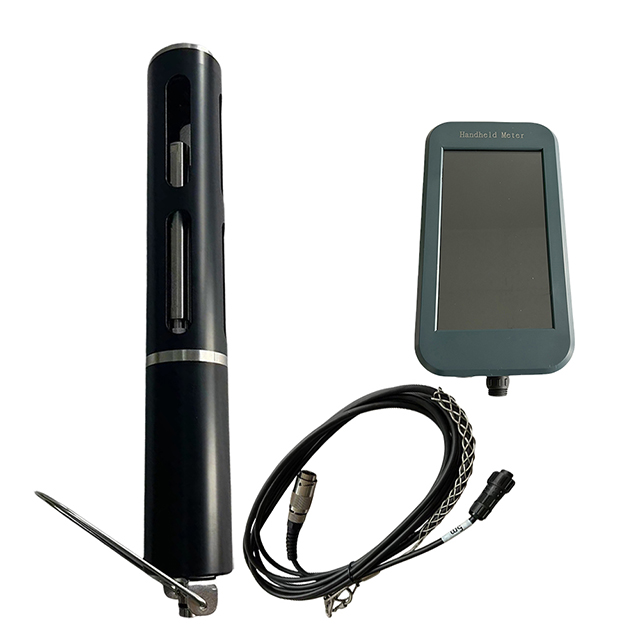
Step 1: Select the Handheld Meter (The Brains): Start by choosing the central terminal. Base your decision on display type (color backlit vs. monochrome), GPS mapping requirements, and internal memory capacity.
Step 2: Choose the Cable Assembly: Select your cable length based on your exact application. A 4-meter cable works perfectly for surface wading and shallow streams. You will need a 30-meter or longer cable for deep groundwater sampling. Consider the number of available sensor ports on the bulkhead.
Step 3: Select Smart Sensors: Populate the available cable ports with your required sensors. You might choose pH, DO, Turbidity, and Conductivity. Utilize blanking plugs for any unused ports. You must seal empty ports to maintain the IP68 waterproof rating.
Step 4: Stock Calibration Standards: You cannot deploy without fresh solutions. Order the correct pH buffers (usually 4, 7, and 10), conductivity standards, and turbidity solutions. You need these for initial setup and ongoing GLP calibration logs.
Step 5: Add Field Accessories: Protect your investment. Consider adding rugged carrying cases. Buy flow cells if you conduct groundwater pump testing. Order anti-fouling guards for high-debris waters, and keep spare optical sensor replacement caps in your kit.
Investing in a high-quality portable multi-parameter tester permanently resolves field data bottlenecks. By moving benchtop accuracy to the field, you cut deployment times and eliminate sample degradation. Utilizing smart, optical sensor technology minimizes routine maintenance and ensures strict regulatory compliance through automated data logging. The ability to monitor pH, dissolved oxygen, and turbidity simultaneously transforms how environmental teams capture defensible data.
Base your final purchasing decision on modularity and verifiable durability. Demand IP67/IP68 ratings, titanium probe housings, and field-replaceable components. These features guarantee your equipment survives the physical abuse of daily field operations.
Take action today to streamline your environmental monitoring. Request a custom quote, download a comprehensive parameter selection guide, or contact a technical specialist to configure a system tailored to your specific water matrix.
A: Optical sensors use luminescence. They require significantly less maintenance, hold calibration much longer, and do not consume oxygen. This means you do not need to stir the water. Electrochemical (Galvanic or Clark) sensors require mandatory warm-up times, frequent membrane replacements, and routine electrolyte fluid refills.
A: Calibration frequency depends entirely on usage frequency and environmental fouling. However, best practices dictate verifying your calibration daily against standard solutions before field deployment. You must recalibrate immediately if the readings drift beyond standard acceptable error margins.
A: Yes. Modern "smart sensors" store their specific calibration data directly on a microchip embedded within the probe itself. This allows them to be disconnected and reconnected to the meter's cable at any time without requiring immediate recalibration.
A: No. In high-quality digital systems, the analog signal is digitized at the probe level before traveling up the cable. Therefore, cable lengths—even extending up to 100 meters—do not degrade the digital signal or affect the accuracy of the readings.